Bhargav Shah
Sep 22, 2026

Three things, and each one matters. First, superannuation guarantee must now be paid with every pay run rather than quarterly. Second, super is calculated on qualifying earnings, a new base that brings together ordinary time earnings and other payments, which means payroll systems mapped to the old definitions can quietly underpay. Third, the ATO's Small Business Superannuation Clearing House closed on 30 June 2026, removing the free utility thousands of small employers depended on.
Miss a payment and the updated superannuation guarantee charge applies: the unpaid super, plus interest, plus administration components, with potential Fair Work exposure on top. The forgiving quarterly buffer is gone. Under weekly payroll, an error can compound fifty two times a year before anyone catches it.
In surveys of tax specialists ahead of the start date, fewer than 5 percent said the businesses they work with were fully prepared. That is not a gap. That is an industry wide exposure, and it is now walking into accounting and bookkeeping firms as urgent work: pay item remapping, clearing house migration, cash flow replanning and catch up on the final quarterly obligations that still had to be cleared on time.
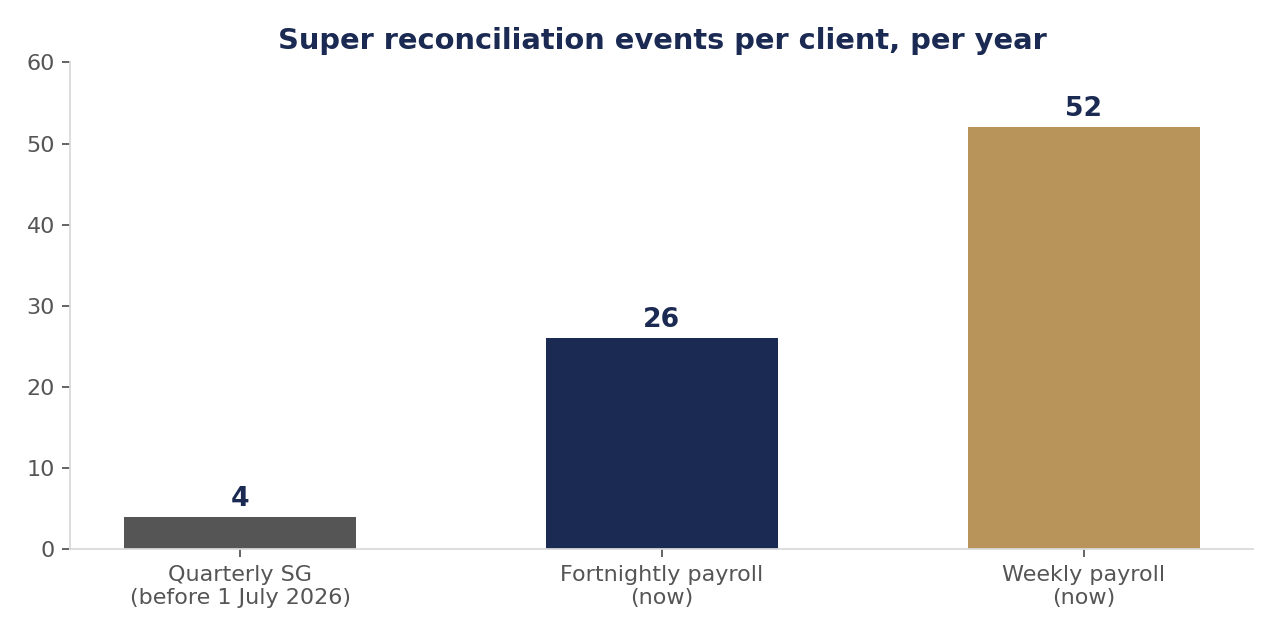
The arithmetic of the workload shift is brutal and simple. A client on quarterly super generated four reconciliation events a year. The same client on fortnightly payroll now generates twenty six. On weekly payroll, fifty two. Multiply across a firm's whole client book and the compliance function has been asked to do roughly ten times the frequency of work with the same team.
The payment frequency change gets the headlines, but the calculation base change is where the quiet underpayments will come from. Super is now assessed on qualifying earnings, a new definition that brings together ordinary time earnings and other payments. Payroll systems that were configured years ago around ordinary time earnings assumptions can keep running without visible error while calculating super on the wrong base from the very first pay run after 1 July.
There is a transition wrinkle for employees too. Workers close to their concessional contribution caps faced the possibility of doubled up contributions in the changeover period, as final quarterly payments and the first payday contributions landed in the same window. Firms that flagged this early saved clients from avoidable excess contribution problems. Firms that did not are now cleaning up.
The practical test any employer can run this week is simple: trace one pay run end to end. When is the super file created, when does the payment leave the account, when does the fund receive it, and is every pay item correctly mapped to qualifying earnings. That one exercise finds most of the failures before the ATO does.
The firms handling this well share one habit: they stopped treating Payday Super as a deadline and started treating it as a product. Payday assurance retainers, payroll systems health checks, contractor classification reviews and real time super monitoring are recurring revenue lines that did not exist as a category two years ago, and clients are actively asking for them.
The firms handling it badly share a habit too: absorbing the extra frequency into existing staff hours and hoping. Hope is not a rostering strategy. Whether the answer is hiring, automation or structured support, the capacity question has to be answered deliberately, because from now on it gets asked every single payday.

.png)



.png)
.png)
.svg)