Bhargav Shah
Oct 09, 2026

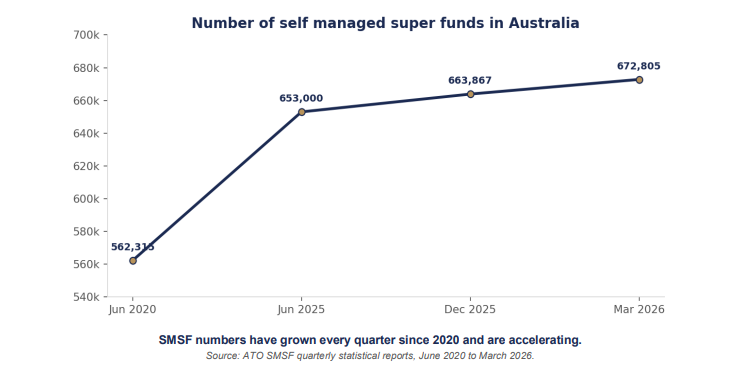
The ATO's March 2026 quarterly statistics read like a growth company's investor deck. There are now 672,805 SMSFs with 1,239,977 members holding an estimated 1.06 trillion dollars in assets. The sector has added 38,885 funds in a single year, growth of 6.1 percent, and it has grown every quarter since 2020, from 562,315 funds in June 2020 to today's record.
The pace is the striking part. The September 2025 quarter set an all time record of 14,612 net new funds. December 2025 set a record for its quarter at 11,646. March 2026 did the same at 11,029, roughly 26 percent above the prior year. The sector had never sustained net growth above 10,000 funds per quarter before. It now does it routinely
Analysts tracking the flows point to a consistent pattern: transfers, increasingly out of large funds and into self managed structures. In the March 2026 quarter, the first negative investment quarter in a year, every APRA regulated fund type lost assets while SMSFs held flat, supported by steady inflows. Australians with meaningful balances are choosing control: over assets, with listed shares at 26 percent of holdings and cash and term deposits at 16 percent, over strategy, and over who advises them.
Demographics sharpen the picture. 85 percent of SMSF members are 45 or older, which means the boom is concentrated exactly where retirement decisions, pension phase transitions and estate questions live. These are not passive accounts. They are the most advice hungry structures in the system.
Every one of the 672,805 funds carries a non negotiable annual workload: an annual return, an independent audit under strict auditor independence rules, member statements, and investment strategy documentation that must actually reflect the fund. On ATO December 2025 data the median fund holds around 932,000 dollars, roughly 68 percent are two member funds, and the sector holds about 178 billion dollars in property, much of it inside limited recourse borrowing arrangements that bring their own compliance choreography.
Now layer 2026 on top. Division 296 turns balance monitoring and valuation discipline into standing work. Payday Super changes contribution timing patterns that funds and their accountants reconcile. And the pension phase decisions of a membership that skews heavily past 45 keep arriving on schedule, whether or not the practice has capacity that month
The result is a sector whose compliance floor rises every year while its professional servicing base barely moves. For SMSF specialists, that is the entire business case in one sentence: recurring, mandatory, judgment adjacent work, growing at six percent a year, attached to the most engaged client base in financial services.
Here is the tension the celebration skips. Wealth Data analysis puts the ratio at 44.5 SMSFs for every financial adviser in the country as at March 2026, a figure that has more than doubled since 2018 as fund numbers climbed and adviser numbers stagnated. Every one of those funds needs an annual return, an independent audit and, increasingly, real advice on contributions, Division 296 exposure and pension strategy
The DIY label has always been slightly misleading. Behind every self managed fund sits an accountant, an auditor and often an adviser doing the managing. A trillion dollar sector growing at record pace is a generational opportunity for those professionals, but only for the practices with the capacity to service it. The funds are arriving every four minutes. The professionals are not.

.png)


.png)
.png)
.svg)