Bhargav Shah
Sep 23, 2026

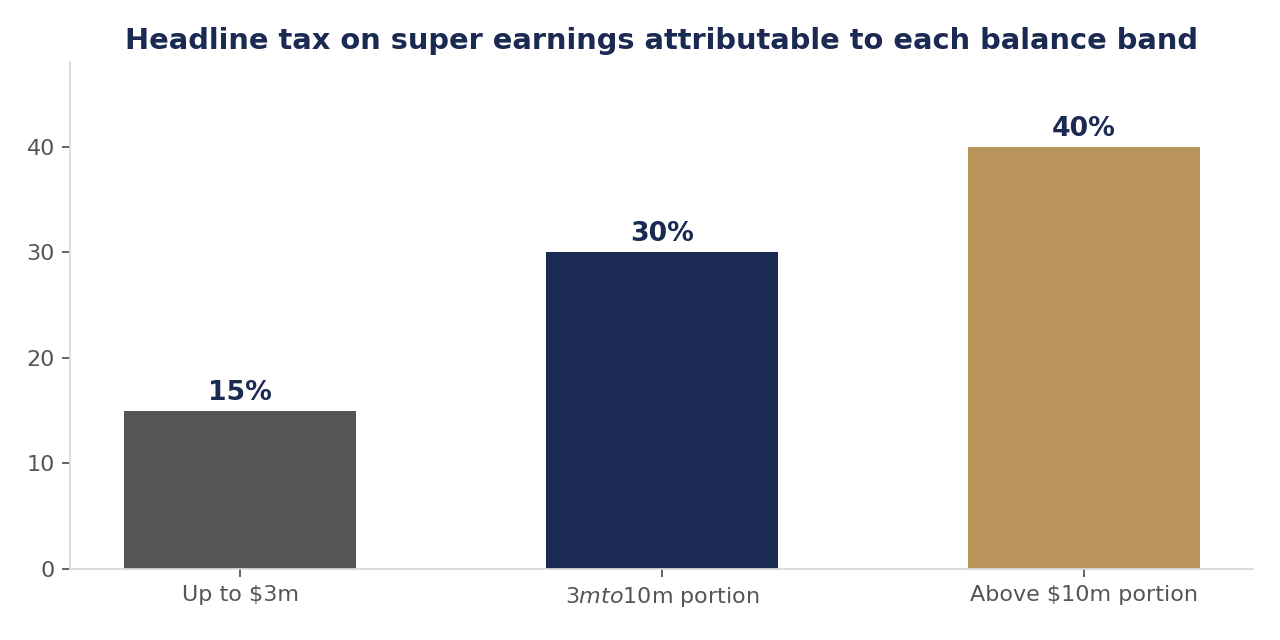
It does not. Division 296 applies an additional 15 percent tax to superannuation earnings attributable to the portion of a member's total super balance between 3 and 10 million dollars, and an additional 25 percent to the portion above 10 million dollars. Someone with 3.1 million dollars is not taxed again on 3.1 million dollars. The additional tax touches only the earnings attributable to the 100,000 dollars above the threshold.
Both thresholds are indexed, the 3 million dollar threshold in 150,000 dollar increments and the 10 million dollar threshold in 500,000 dollar increments. The frozen threshold argument, one of the strongest criticisms of the original design, was answered in the redesign.
It did, in the original design, and that is what nearly sank it. Taxing unrealised gains drew sustained objection from professional bodies, SMSF practitioners and economists. In October 2025 the Treasurer announced the redesign: the tax moved to a fund level realised earnings approach, the second threshold was added, and the start date shifted to 1 July 2026.
The first total super balance test lands on 30 June 2027, with the first assessments to follow in the 2027 to 2028 year. Reasonable people still disagree about the policy itself. Supporters say concessions at the very top were never the system's purpose. Critics say the rules changed on people who planned in good faith. Both views deserve honest airing. What is no longer accurate is the claim that the tax reaches paper gains.
Because the first balance test does not land until 30 June 2027, there is a temptation to file Division 296 as next year's problem. The better practices are treating this financial year as the planning window it actually is. The nature and timing of realised earnings now matters in a way it never did inside super, which puts asset level decisions, disposal timing and the split between accumulation and pension interests on the table for every large balance client.
Contribution strategy changes shape too. A member approaching the 3 million dollar threshold now weighs every additional contribution against future Division 296 exposure, while indexation of the threshold in 150,000 dollar increments means the line itself moves over time. Modelling that interaction is precisely the kind of advice clients will happily pay for, because the stakes are visible and personal.
And underneath it all sits hygiene: clean cost bases, defensible valuations and contemporaneous records. Funds holding property or unlisted assets will feel this most, since attributable earnings calculations are only as credible as the valuations behind them. The firms tightening valuation discipline now are buying their clients calm in 2027.
Here is the part the headlines miss. The ATO counts 672,805 SMSFs holding 1.06 trillion dollars for nearly 1.24 million members. Only a small minority of members sit above 3 million dollars. But every fund approaching the line wants modelling, every trustee wants to understand realised versus accrued earnings, and every accountant now needs valuation discipline and clean cost bases as standing practice, not year end catch up.
Division 296 is, in effect, a new permanent workstream for the SMSF profession: balance monitoring, contribution strategy around the thresholds, and clear client conversations about a tax most clients will never pay but almost all will ask about. The tax is narrow. The administration is wide.

.png)



.png)
.png)
.svg)